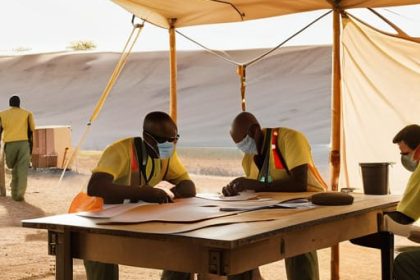
I spent nine years watching NGOs spend millions on “awareness campaigns” and glossy brochures that explain, in excruciatingly polite detail, how refugee status is determined. They talk about legal frameworks, international treaties, and the sanctity of the asylum process as if it’s a clean, mathematical equation. But I’ve sat in dusty transit camps in South Sudan and watched people lose everything while a bureaucrat in a climate-controlled office debates the nuance of a single testimony. To the people on the ground, the legal theory is noise; what actually matters is whether the paperwork moves or if the person behind the desk decides you don’t exist.
I am not here to give you a lecture on the 1951 Convention or the theoretical nuances of international law. I have seen too many people get lost in the gap between the law and the reality of the border. Instead, I am going to tell you how this process actually functions when the systems are strained and the resources are thin. I will strip away the academic jargon and show you the mechanical reality of the grind, because understanding the machinery is the only way to navigate it.
Table of Contents
More Than Just Paper the Grounds for Seeking Asylum

In the field, you quickly learn that people don’t flee because of a change in political climate; they flee because the ground beneath them has become untenable. When we talk about the 1951 Refugee Convention definition, the legal textbooks focus on the mechanics of race, religion, or political opinion. But on the ground, those categories are often messy and overlapping. A person isn’t just fleeing a regime; they are fleeing the specific, localized reality of persecution and well-founded fear that a bureaucrat in a distant capital might struggle to categorize.
The actual grounds for seeking asylum often boil down to a single, terrifying question: can you survive another week in your home? During the asylum seeker interview process, officials look for consistency in a narrative, checking if the story aligns with the formal legal frameworks. I’ve seen people who have survived unimaginable logistical nightmares—traversing borders with nothing but the clothes on their backs—struggle to translate that raw survival into the sterile, structured language required by the system. It is a brutal disconnect. The law requires a specific type of proof, but survival rarely leaves you with a clean paper trail.
The Thin Line Between Flight and Persecution and Well Founded Fear

In the field, you see the gap between what a person is running from and what a legal clerk can actually verify. There is a massive, messy distance between someone fleeing a collapsing economy and someone fleeing targeted violence. Under the 1951 Refugee Convention definition, the distinction is everything. You can be starving because the crops failed, or you can be starving because a militia burned your granary to force you out. One is a tragedy; the other is a legal claim. The problem is that when you are sitting in a transit camp, you don’t always have the luxury of categorizing your trauma into neat, bureaucratic boxes.
When it comes to the asylum seeker interview process, this is where the wheels often fall off. The officials aren’t looking for your life story; they are looking for specific markers of persecution and well-founded fear. They need to see that the threat is individual, not just general instability. I’ve seen people who have lost everything—homes, families, livelihoods—get turned away because their suffering looked too much like “general unrest” rather than “targeted persecution.” It is a brutal, clinical way to judge a human life, but in the world of status determination, if you can’t prove the motive behind the flight, the paperwork simply won’t move.
The Gap Between Law and Reality
Lawyers will spend months debating the nuances of ‘well-founded fear’ and the legal definitions of persecution, but in the field, status isn’t determined by a textbook; it’s determined by whether a person can prove they survived the journey long enough to sit in the interview chair.
Yusuf Lindqvist
The Final Manifest

At the end of the day, determining refugee status isn’t an academic exercise in legal theory; it is a high-stakes audit of a person’s survival. We have looked at the necessity of proving a well-founded fear and the specific, narrow categories of persecution that the law recognizes. But stripped of the jargon, the process is simply about whether a person’s narrative holds up under the weight of bureaucratic scrutiny. It isn’t enough to have suffered; you have to prove that the suffering was targeted, predictable, and that the state failed to protect you. If the documentation is missing or the testimony falters, the entire mechanism breaks down, regardless of the reality on the ground.
I spent years watching trucks sit idle at borders because a single stamp was missing, and I see the same thing happening in these legal halls. The system is designed to be a sieve, catching the legitimate while letting the desperate slip through the cracks of technicalities. However, we cannot let the complexity of the law blind us to the human necessity behind it. The goal of these legal frameworks shouldn’t be to find reasons to say ‘no,’ but to build a reliable bridge to safety. If we get the logistics of justice right, we ensure that the people who have lost everything finally find the one thing that matters: a place to exist without fear.