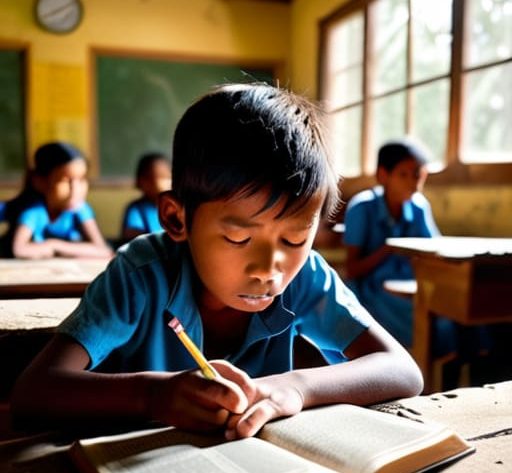
I remember sitting in a dusty office in Goma, staring at a spreadsheet that claimed we had achieved a 90% primary school attendance rate. On paper, it was a triumph; in reality, the classroom was just a collection of bodies sitting in the heat. We had successfully moved the people, but we hadn’t moved the value. This is the fundamental disconnect in development: we obsess over the headcount while ignoring the actual payload. Everyone wants to talk about the metrics of access, but nobody wants to admit the uncomfortable truth of why school enrolment rose but learning did not.
I’m not here to give you a lecture on pedagogical theory or high-level policy frameworks. I’ve spent too many years tracking shipments of vaccines and grain to care about academic abstractions. Instead, I’m going to look at this through the lens of supply chain integrity. I will show you how the “last mile” of education is failing, not because of a lack of intention, but because we are treating knowledge like a commodity that delivers itself. We are going to stop looking at the enrollment numbers and start looking at the delivery of the actual goods.
Table of Contents
The Illusion of Presence Schooling vs Learning Distinction

In my years managing supply chains, I learned that a manifest showing a delivery doesn’t mean the cargo was actually used. You can track a shipment of vaccines to a village clinic, but if the cold chain broke halfway through the transit, those vials are just expensive water. Education follows the same flawed logic. We focus on the schooling vs learning distinction as if it were a theoretical debate, but in the field, it is a physical reality. We count heads in a classroom and call it progress, yet we ignore the fact that the “cargo”—the actual instruction—is often missing or spoiled.
When we look at the data, the gap between educational outcomes vs enrollment rates becomes glaringly obvious. We see massive spikes in registration numbers, which looks great on a donor’s quarterly report, but these numbers are often hollow. It is easy to build a structure and seat a child in it; it is much harder to ensure that the child is actually absorbing something. If the teacher is under-resourced or the curriculum is a relic of a different decade, you haven’t built a school—you’ve just built a warehouse for children. The presence of a student is not the same as the presence of an education.
The Growing Gap in Educational Outcomes vs Enrollment Rates

I’ve spent enough years watching fuel gauges drop and bridge crossings fail to know that a delivery isn’t complete just because the paperwork says the truck left the warehouse. In the same way, we are seeing a massive disconnect between the sheer volume of bodies in classrooms and the actual educational outcomes vs enrollment rates being reported in annual reviews. We celebrate the metric of a child sitting at a desk, but we ignore the reality that they are often sitting there in total silence, unable to decode the very words on the chalkboard.
This is where the concept of learning poverty in developing nations becomes a logistical nightmare rather than just a statistic. You can allocate every cent of a budget toward building structures and buying uniforms, but if the resource allocation in education systems doesn’t account for the actual mechanics of instruction, you’re just building expensive warehouses for idle time. I’ve seen it in the field: the seats are full, the attendance registers are signed, but the actual transfer of knowledge is non-existent. We are successfully scaling the infrastructure of schooling, but we are failing the delivery of the actual service.
The Empty Warehouse Problem
“In my experience, a manifest full of supplies is just a piece of paper if the inventory never makes it to the shelf. We’ve treated school enrollment like a successful delivery, counting every head in a desk as a completed shipment, but we’ve forgotten to check if the actual cargo—the learning—ever cleared customs.”
Yusuf Lindqvist
Beyond the Paper Trail

We have spent years celebrating the numbers on the spreadsheet, mistaking a high enrollment rate for a successful mission. But as I learned in the field, a manifest full of supplies is useless if the crates are empty or the truck breaks down ten miles from the camp. In education, we have successfully moved the children into the buildings, yet we have failed to move the actual substance of learning into their minds. We are tracking presence instead of progress, and until we stop treating a crowded classroom as a finished objective, we are simply managing a crisis of stagnation rather than solving one.
If we want to fix this, we have to stop looking at the appeal totals and start looking at the delivery. We need to pivot our metrics away from how many seats are filled and toward how many students can actually read the instructions on a medical kit or a seed packet. It is not enough to just show up; we have to ensure that the actual payload—the knowledge, the skills, the literacy—reaches its destination. The goal isn’t to build a school; the goal is to ensure the knowledge arrives.